

Navigating the In-House Legal Job Market in Redundancy: A Guide for Experienced Counsel
Returning to the in-house legal job market having developed a successful career as in-house counsel can sometimes feel overwhelming when facing redundancy, depending on your role. The majority of the advice here is common to anyone seeking a new position, but redundancy requires some additional focus when it comes to mindset and getting up to speed with how the job market may have changed since you took up your most recent role. Once in-house, you can become hostage to fortune in cases of corporate consolidation if the business is experiencing financial challenges. The question below is a good example of what we are often presented with:
“I am a lawyer who is being made redundant from my company after several years. I haven’t looked at the recruitment market for a long time since my previous job changes have tended to be presented to me out of the blue. So, I don’t have much experience finding jobs when I need to drive the process. I think it might be tricky to navigate the in-house legal jobs market, owing to uncertain macro-economic conditions. Redundancy is also affecting my confidence. I’ve never used LinkedIn as a candidate and, as a senior lawyer who qualified over 10 years ago, I’m a concerned that roles will go to people with much less experience. What advice and tips can you give me to move me in the right direction in finding another in-house legal job?”
– Anon
Mindset and Strategy
The first thing to focus on is your mindset.
Regardless of how senior you are, or whether you are part of the acquirer or a business being bought, redundancy, especially at a senior level, can feel daunting, emotionally and practically. It’s important to remember that redundancy (handled well) is almost always about your role, rather than your professional capability. Try not to take it personally. The legal recruitment market in the UK can often be challenging – particularly for senior lawyers chasing much less common senior roles. However, senior in-house lawyers continue to find fulfilling roles by leveraging their experience, networks, and by presenting themselves strategically. Apart from perhaps the most narrowly focused subject matter experts, or regulatory lawyers with skills relevant to just one industry sector, you will have skills that are transferrable to other industry sectors. What’s more, moving into a new sector can be beneficial to your longer term marketability.
The four most important things to remember at the outset are:
- Clarify what you want from your next role: industry, size of company, work-life balance and salary expectations according to whether you are in London or the Regions.
- Treat your job search as any other project: set goals, timelines, and track your progress.
- View redundancy as an opportunity: reassess your career goals and explore new avenues – don’t view it as a personal setback.
- Maintain a positive mindset: the market may fluctuate but your experience remains valuable. Remember those transferrable skills.
Managing the Changing Job Market as an Experienced In-House Lawyer
The legal job market always presents challenges for senior lawyers with at least 10 years’ experience. The rise of platforms like LinkedIn and Indeed have created a more competitive environment for in-house legal positions whatever the nature of the prevailing economic climate. Whether you have gained really broad experience, or have in-depth knowledge in one specialist area, your experience will be an attractive and valuable asset to other companies when properly positioned.
Understanding how to navigate this landscape is crucial for experienced lawyers who may not have actively pursued job opportunities in recent years.
Although there is no precise publicly available data on this point, our experience (which is broadly in line with wider industry estimates) is that well over 70% of senior in-house legal positions are filled through targeted recruitment (ie search and headhunting) rather than open job adverts. And this pattern is trickling down into more junior and mid-level roles. In our experience, fewer than one in five suitably qualified lawyers are actively looking for a move at any one time, which is why employers increasingly rely on search (ie headhunting).
This highlights the importance of strategic networking and personal branding, particularly for senior legal professionals. If you’ve ever wondered why another in-house lawyer posts content about topics you might be interested in – this is why! The key is transforming perceived challenges—such as extensive experience—into demonstrable advantages for potential employers.
Breaking Down Your Job Search: The Project Management Approach
As an experienced legal counsel, you’ve managed complex legal projects throughout your career. Your job search deserves the same structured approach:
Phase 1: Self-Assessment and Planning
Before diving into applications, take time to conduct a thorough self-assessment:
- Skills Audit: Catalogue your technical legal skills, industry knowledge, and soft skills that have developed throughout your career.
- Achievement Inventory: Document specific achievements, focusing on commercial impact and value added to previous organisations.
- Values Clarification: Identify what truly matters to you in your next role beyond compensation—company culture, work-life balance, industry sector, or growth opportunities.
- Market Position: Determine your unique value proposition as a senior legal counsel with extensive experience.
This foundational work will inform every subsequent stage of your job search and help you target roles where your experience is genuinely valued.
Phase 2: Optimising Your Digital Presence
Your online presence, particularly on LinkedIn, requires careful attention:
- Profile Enhancement: Develop a compelling profile that emphasises commercial acumen and business partnership rather than just technical legal skills.
- Keyword Optimisation: Ensure your profile contains current industry terminology and in-demand specialisations.
- Strategic Content Engagement: Establish a routine for thoughtful engagement with relevant content in your field. This is content posted by others.
- Thought Leadership: Ideally, share insights that demonstrate your forward-thinking approach and awareness of current legal developments, especially if this helps to showcase what you have been working on.
- Post Personal Content: Even if all you do is do a post about being “on the move to pastures new”, you must post something. Posts about you coming to the end of an era at Acme Widget Corporation, and tagging colleagues you have enjoyed working with will enhance visibility and engagement on LinkedIn. Even if you have fewer than 500 connections, you’ll be surprised at the number of likes and good wishes you will receive. Do some research on the best times to post, for maximum reach and engagement. Post a personal photograph, with you and some colleagues in it.
Phase 3: Activating Your Network
While you may not have actively sought roles in the past, your professional network is likely to be substantial. If it’s not, then now is the time to build your network. Forget how much law you know. Right now, your network will be your most powerful asset:
- Relationship Mapping: Identify key relationships in your network, including former colleagues (both legal and non-legal), counterparties, legal contacts from the same industry and lawyers from panel firms.
- Strategic Reconnection Plan: Create a structured plan for reestablishing meaningful connections. Build a list. Focus on commonality and quality over quantity.
- Knowledge-Sharing Approach: Position your outreach as sharing experiences rather than openly seeking job leads, which maintains professional dignity during transition. It’s peer-to-peer networking, not sales. Start with every practice lawyer you know, or have ever worked with. You work in-house and you are on the move. They ought to want to know you when you pop up somewhere else.
- Events and invitations: Say ‘yes’ to everything you are invited to where other lawyers might be in attendance. Talk to as many people as possible. Don’t get stuck with one delegate; have a polite exit strategy that allows for a follow-up over coffee (even if just virtual). Agree to reconnect and share perspectives on something of common interest. Make sure you follow up. Introduce folk to one another, which itself gives you a convenient exit from a small group at a networking event.
- Legal Recruitment Specialist Partnerships: Build relationships with specialist legal recruiters and executive search firms who understand the value of experienced counsel. Legal sector specialists will often have access to senior roles which have not been advertised anywhere. They can advocate on your behalf. You can register as a candidate here. It takes 5 minutes.
Phase 4: Targeted Application Strategy
When actively applying for roles:
- Selective Approach: Again, place your focus on quality over quantity in applications, thoroughly researching each organisation. Ask how they fit with the self-assessment you went through in Phase 1.
- Tailored Communication: Customise your CV and cover letter for each role, highlighting relevant experience and achievements.
- Value Narrative: Frame your experience as providing day-one impact without extensive onboarding.
- Interview Preparation: Prepare examples that demonstrate adaptability, commercial awareness, and continued professional development.
Leveraging LinkedIn: Beyond the Basics
LinkedIn has evolved substantially in recent years and requires a strategic approach, especially for experienced professionals:
Profile Optimisation for Senior Legal Counsel
Your LinkedIn profile should be optimised with key terms that both human recruiters and automated systems recognise:
- Headline Strategy: Whether your job title is Legal Counsel, Head of Legal or General Counsel, create a headline that goes beyond this to highlight your particular value proposition.
- About You: Write an “About” section containing a concise, engaging narrative on your career history, key achievements and what you offer.
- Experience Description: Focus on outcomes and business impact rather than responsibilities. Think of the problems key stakeholders have lost sleep over and how you helped to overcome them. Fill your experience section with results-driven bullet points that quantify your impact.
- Recommendations Strategy: Curate recommendations that demonstrate your current relevant skills, commercial awareness, organisational skills and how great it was to have you on the team. Make it mutually beneficial by offering them a recommendation in return.
- Skills Endorsement Curation: Regularly update skills to reflect current legal technology proficiency and commercial competencies.
Content Engagement Strategy
How you engage with content on LinkedIn, demonstrates the currency and relevance of your professional knowledge and sector experience:
- Strategic Commenting: Provide insightful comments on trending legal and business topics either based on your own personal experience or even just commenting as a newcomer to the issues being discussed. They don’t need to be lengthy.
- Selective Sharing: Share articles with thoughtful commentary that demonstrates commercial awareness. Ask what others think.
- Original Content Development: Consider creating short posts on legal developments relevant to your target industries. Invite comments.
- Group Participation: Engage in specialist legal and compliance groups that align with your expertise and target sectors.
TOP TIP: Not sure how easily recruiters can find you on LinkedIn? Consider taking a Headhunter Visibility Assessment. Ours is free and designed for senior lawyers aiming for General Counsel roles, though most of the principles apply at every level. With your results, you’ll receive a free LinkedIn Playbook showing exactly where to start if you want more approaches from legal recruiters you don’t yet know.
CV Optimisation for the Experienced In-House Lawyer
Your CV requires careful crafting to highlight the value of your experience:
Structure and Emphasis
- Tailor Your CV: Make sure you review your CV for each application. Make a new version and adapt it to the opportunity by using keywords and phrases from the job description, in case an internal recruiter (who is not familiar with the legal profession and doesn’t habitually recruit lawyers) is forced to rely on AI to pick people from 200 plus applications to advance into the screening process.
- Achievement-Led Format: Lead with the impact you made personally and the benefits to the business, rather than just a bulleted ‘shopping list’ of responsibilities. It’s perfectly acceptable to describe your responsibilities (in order to make use of relevant keywords), but more as a summary of your remit, to put your role in context. Highlight your most relevant experience, specialisations, and measurable achievements (e.g., “Led a project to streamline the management of contracts with 15% cost savings”).
- Professional Summary: There are two schools of thought on whether you should include a summary or personal statement at the top of your CV. Most recruiters who specialise in the legal profession won’t need to see one, since they will be able to compare your CV with others, at a glance, and prioritise it accordingly. However, you might need one for direct applications.
- Relevance Filter: Emphasise the most recent and most relevant experience for the ideal roles and industries you have within your sights. Expect to refine your CV for each role you apply for. It’s never a one-size-fits-all activity. Once you have some professional ‘mileage’, we appreciate there’s lots to say about what you have done. So one approach is to start with a catch all CV (which might mirror your LinkedIn profile) and edit it down job by job.
- Technology Proficiency: Highlight adaptability and proficiency with current legal technology. What’s current, or emerging? What systems have you researched and implemented at each company?
- Continuous Learning: Showcase recent professional development and contemporary knowledge. What training and development programs have you attended? What training have you given to others? Emphasise the practical and commercial industry relevant subject matter, rather than overly academic topics. There is often a balance to be drawn.
Language and Presentation
- Commercial Terminology: Integrate business language alongside legal terminology. The likelihood is that both lawyers and non-lawyers will read your CV. So you may not want to come over as too legalistic.
- Quantified Impact: Include metrics and specific business outcomes where possible. If you reduced company expenditure on a project, say so in a way that makes it easy for an outsider to understand. If you negotiated a settlement in a dispute, how much financial or reputational risk was there?
- Strategic Editing: Streamline early career details while emphasising progression and increased responsibility. When drafting a CV, you don’t need chapter and verse for every role you have ever performed. Place the emphasis on the roles which are either most recent or relevant to your desired outcome. Don’t divorce your experience from your career history. It’s a bad idea to lump all your experience together under one section headed “Experience”, whilst simply listing a bunch of companies under “Career History”. You need people to see the trajectory and how your career developed role by role. If you feel something might be perceived as a step back, deal with it briefly in the document or in a covering letter/email, and be prepared to elaborate in the interview.
- Visual Clarity: Ensure impeccable formatting that reflects attention to detail. Explain every gap. State whether each role was interim or permanent. You won’t do yourself any favours if your CV has a number of short to medium-term interim roles listed on it and you don’t describe them as such. If you want to include a reason for leaving, you can. Don’t make it too short. Two sides is a myth. Furthermore, in today’s world you will sacrifice keyword opportunities for the robots to identify if you make it too short. You are a senior lawyer so it needs to have some ‘weight’ without you turning it into War and Peace, or engaging in ‘keyword stuffing’. No matter how much AI is adopted, it still needs to be read by humans. It’s the humans that will want to work with you; and they will make the hiring decision!
Put yourself in the shoes of the hiring manager. Make it easy for them to read in a hurry.
Time-Saving Approaches to Legal Job Searching
Efficiency is crucial when managing a job search alongside other commitments:
Automation and Organisation
- Job Alert Customisation: Set highly specific parameters on legal job boards to reduce noise. As an in-house lawyer, the chances are you will want to remain in-house rather than going ‘back to the dark side’. So, at its simplest, this is likely to be driven by job title. Using LinkedIn’s standardisation, you will cut out the noise by using a combination of the most common in-house legal job titles. Don’t be too specific or you might miss something that has been given the wrong description. However, if you are a corporate lawyer or commercial lawyer, you might notice you see too many roles in practice.
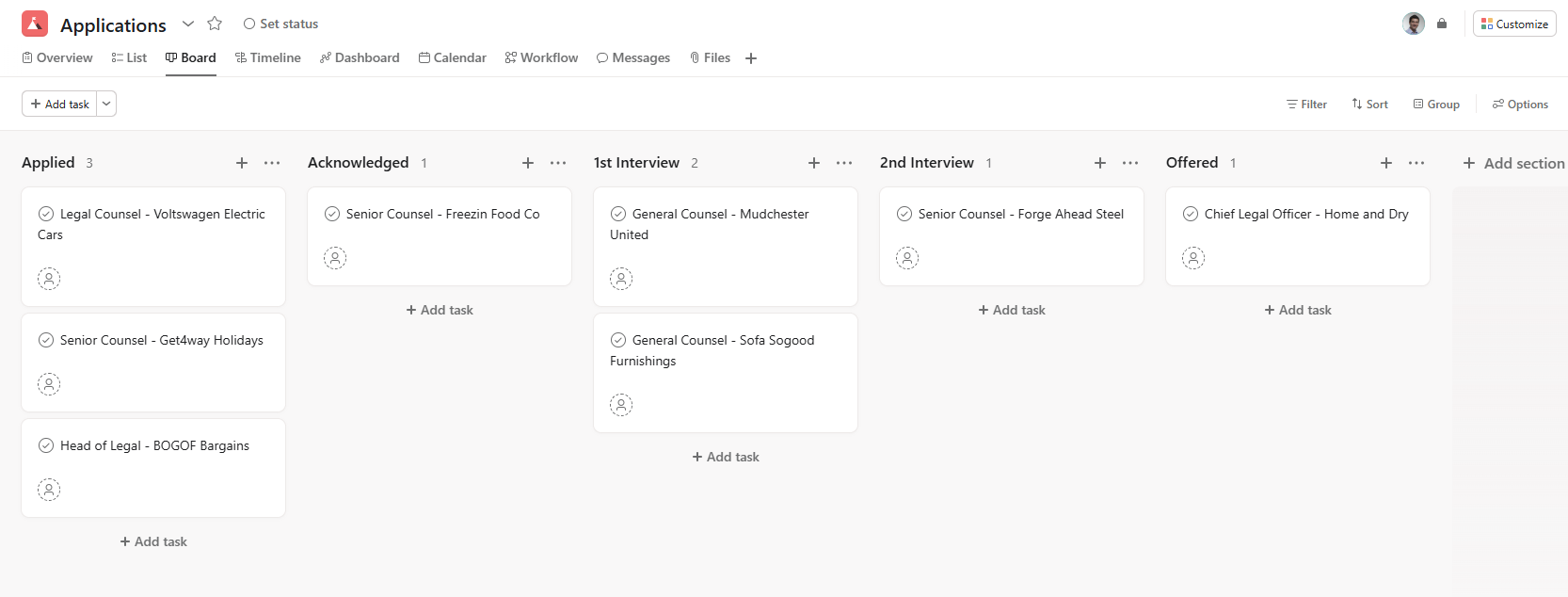
- Application Tracking System: Develop a personal system to track applications and follow-ups. A spreadsheet will suffice at the very least, and some candidates manage everything in email, with folders for each job application. However, you might be able to stay on top of more information if you track stages with one of the many free online project management systems. A good example of something free and feature-rich is Asana where you can track applications in a Kanban board, where you are able to use a card to represent each job and move it from column to column as your application progresses (see figure 1). You can also include notes and attachments like job specs, names of people in the hiring process, together with links to their professional profiles.
Time Blocking and Routine Development
- Template Development: Create customisable templates for different types of job applications but make sure you personalise each one.
- Dedicated Search Time: Searching for a new job can be exhausting – especially when you get to interview stage. So, break things down and allocate specific time blocks for job search activities rather than continuous monitoring. Focused work beats a scattergun approach every time. Curate a list of recently advertised roles that look interesting and use a batched approach in your applications.
- Network Engagement Schedule: Establish a sustainable routine for growing and maintaining your personal network. Dedicate time to make new connections amongst your peer group in other companies, or better still the level above you. Whilst they may not be hiring currently, forward thinking General Counsel and Chief Legal Officers will want to engage with you if you have things in common.
- Maintain Wellbeing: Redundancy adds to the mental load of in-house life rather than lifting it, so build regular breaks and recovery time into your week. Stay active, get plenty of fresh air, and treat rest as part of the job search, not time away from it..
Addressing Seniority Concerns
- Highlight Benefits of Seniority: Many employers value senior candidates for their experience, judgment, and ability to mentor team members even if they are not managing a team. Highlight these strengths in your CV and interviews.
- Be Flexible: Consider broadening your search to include interim, consultancy, or portfolio roles, which can be more accessible for senior professionals and may lead to permanent opportunities if these are your ultimate objective. Be open to in-house, government, or even practice roles – even if just to keep some continuity and stability on your CV. You won’t be the first or last person to move back to practice for a period of time, and an increasing number of law firms have developed roles which suit people with in-house legal expertise.
Rebuilding Confidence During Transition
The psychological impact of redundancy requires careful management:
Practical Confidence-Building Strategies
- Achievement Journal: Maintain a record of past successes and positive feedback, recommendations and testimonials. The ideal approach is to keep doing this as you navigate each role and relationship with your stakeholder ‘fan base’. But if you haven’t done this now is the time to start.
- Skill Development: Identify and address any skill gaps to boost confidence in your marketability and deal with any challenging interview questions where you may not be perceived as having as much experience as the so-called “ideal” candidate. Remember they very often don’t exist, and some of the experience you have, others on the shortlist will lack. Think about comparable experience and transferrable skills. For example, although the substantive legal and compliance framework may vary from industry to industry, the approach to dealing with regulators in one sector may be very similar to another.
- Professional Support and Coaching: Connect with other senior legal professionals who have successfully navigated transitions from one in-house role to another in similar circumstances to you. Ask your company to pay for some outplacement advice as part of your exit. Be wary of generalists without experience of the legal profession and make sure the advice you receive is relevant. Some specialist legal recruiters offer outplacement support at a lower cost than large consultancies, so ask before you commit. Consider working with a career coach who specialises in legal careers.
Conclusion: The Strategic Advantage of Experience
Whilst the recruitment market will always present you with challenges to navigate, your extensive experience as a senior in-house lawyer will offer distinct advantages to a potentially wide range of organisations. By approaching your job search as a structured project, optimising your digital presence, and leveraging your established network, you can navigate this transition successfully.
The legal profession continues to value wisdom, judgement, and commercial acumen—qualities that develop with experience. By following the framework outlined in this guide, you can present yourself as not just experienced, but also adaptable, commercially minded, and ready to add immediate value to your next organisation.


